Interoperability: what GouvNum could change for you
On 16 October 2026, Senegal installed its Digital Governance Committee, GouvNum. Among its priorities is a rather technical word: interoperability. Behind it lies a very concrete promise: never again having to give the state a document it already holds.
A committee to keep the state moving in step
Created by decree in March 2025 and installed by the Prime Minister on 16 October 2026, GouvNum brings ministries and public agencies together around a single goal: making the state's digital projects consistent with one another, instead of each moving forward on its own. The Ministry of Telecommunications and Digital Affairs acts as its secretariat.
The targets set for 2034 are ambitious: 90% of administrative procedures available online and 90% of citizens with a digital identity. They are part of the Technological New Deal, which already led to the launch of the e-senegal.sn portal in March 2026, where you can request your criminal record or certificate of nationality online.
One point in the committee's presentation caught my attention: native interoperability, with a single identifier and the same interfaces for every administration. The committee cites three references: Rwanda's Irembo portal, Benin's digital identity and X-Road, Estonia's data exchange system.
Interoperability, simply explained
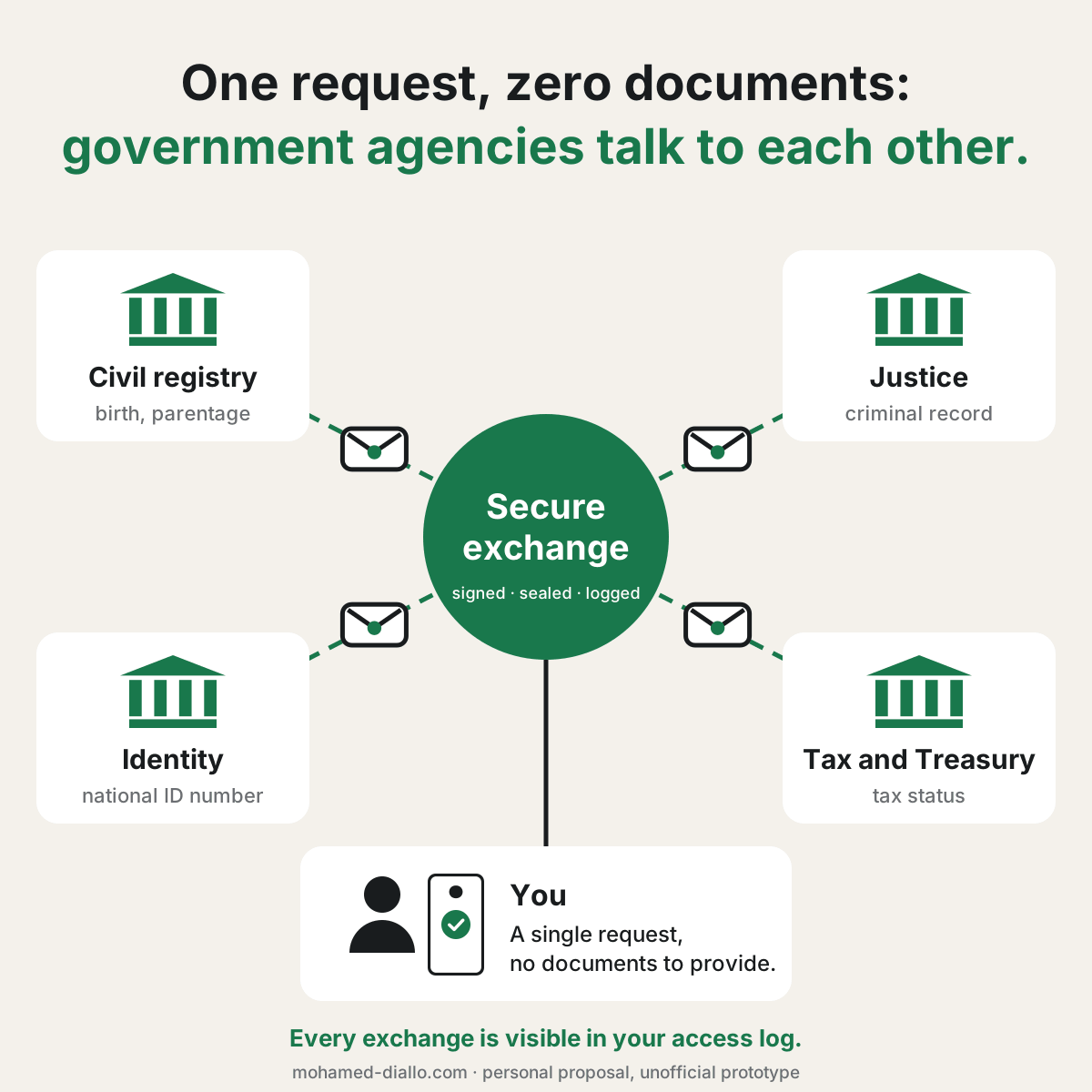
Today, each administration keeps its own registers: the civil registry knows when you were born, the Justice ministry knows your criminal record, the tax office knows your tax situation. But these registers rarely talk to each other. When one administration needs information held by another, you are often the one playing postman: you fetch the document from one office and hand it in at the other.
Interoperability means letting administrations exchange this information directly and securely. Picture a sealed envelope travelling between two offices:
- it is signed: whoever receives it knows exactly who sent it;
- it is sealed: nobody can read or alter it on the way;
- it contains only the answer that is needed ("yes, this person was born on this date"), not your whole file;
- every exchange is recorded in a log.
One important point: this is not about building one big central database where everything is gathered. Each administration keeps its data at home; only the necessary answers travel. That is how X-Road has worked in Estonia since 2001.
A concrete example: the criminal record
Being able to request your criminal record online is already real progress. On e-senegal.sn, for people born within the jurisdiction of the pilot courts, the procedure costs 1,500 FCFA and the announced turnaround is one day.
Looking more closely, I noticed that citizens are still asked to provide a copy of their birth certificate or identity card. Yet this information already exists in the state's registers. That makes sense as long as the registers do not talk to each other: the Justice ministry has no other way to check your identity and date of birth. So the procedure has been digitised, which is a first step. The next one is to simplify it.
With interoperability, the process could look like this:
Step | Today | With interoperability |
|---|---|---|
Prove your identity | Upload a copy of your ID card | Log in securely |
Prove your birth | Provide a birth certificate | The Justice ministry queries the civil registry directly |
Check the document | An officer checks a copy | The information comes from the official register |
Know who saw your data | Impossible | Visible in an access log |
What it would change for you
Interoperability is not a topic for IT people only. Done well, it can change three very concrete things in everyone's life.
1. Zero supporting documents. The principle is simple: the state never asks citizens again for information it already holds. You would only be asked for a document if the information exists in no register. Fewer trips, fewer copies, fewer queues, and less risk of forged documents.
2. Knowing who has looked at your data. If administrations exchange your information, you must be able to see who consulted it, when and why. In Estonia, every citizen has such an "access log". That is what turns trust into something you can verify.
3. Procedures for everyone, including people who cannot read. According to the latest census, 62.2% of Senegalese aged 10 and over can read and write. More than one person in three therefore cannot fill in an online form on their own. But if there are no more documents to provide and no form to fill in, a procedure can be done by voice message, in one's own language, on WhatsApp, by phone or at an assisted counter.
The conditions for it to work
Interoperability is not a magic wand. For it to deliver on its promise, three conditions seem essential to me.
Reliable registers. An exchange system faithfully passes on what is in the registers, errors included. The modernisation of the civil registry undertaken by ANEC is therefore the foundation for everything else.
Privacy protection. Connecting administrations must not make it possible to know everything about everyone. Each exchange must have a legal basis, pass on only what is strictly necessary and remain under the oversight of the Personal Data Protection Commission (CDP).
No one left behind. Digital services must be added to counters, not replace them. People who are not connected, who live far away or who cannot read must keep access to assisted services.
What next?
Senegal has laid the right foundations: a single portal, a modernised civil registry, and now digital governance carried at the highest level of the state. Interoperability is the piece that can connect all of this and turn procedures that are online into procedures that are truly simple.
In upcoming articles, I will explore what this would take in practice: an identifier assigned at birth, an access log for every citizen, procedures accessible by voice, and sovereignty over our data.
And you: what document were you recently asked for that the state already had?
The opinions expressed here are my own. The demonstrations presented are unofficial personal prototypes that use fictitious data only.
Sources
- Installation of GouvNum on 16 October 2026 — Osiris
- Decree creating GouvNum (March 2025) — Osiris
- GouvNum's work programme — AfriqueITNews
- Video "Installation du Comité de Gouvernance du Numérique (GouvNum)", MTN GOUV SN YouTube channel, 18 October 2026 (2034 targets and presentation slide)
- Launch of e-senegal.sn — Osiris
- "Casier judiciaire (juridictions pilotes)" page on e-senegal.sn, accessed 11 November 2026
- Literacy in Senegal, RGPH-5 census — ANSD via vie-publique.sn
- X-Road and the "once-only" principle in Estonia — GovInsider
- Data Tracker access log in Estonia — RIA